CSW70 Agreed Conclusions: PSI Welcomes Labour Rights Advances but Warns of Shortcomings in Recognizing Care as a Human Right
Mar 12, 2026
Adopted in New York on 9 March, the conclusions commit to equal pay, an end to workplace discrimination, and stronger protections against violence and harassment - while exposing deep political resistance by the United States after a first-ever recorded vote. At the same time, the final text still stops short of recognising care as a human right guaranteed through universal, publicly funded systems.
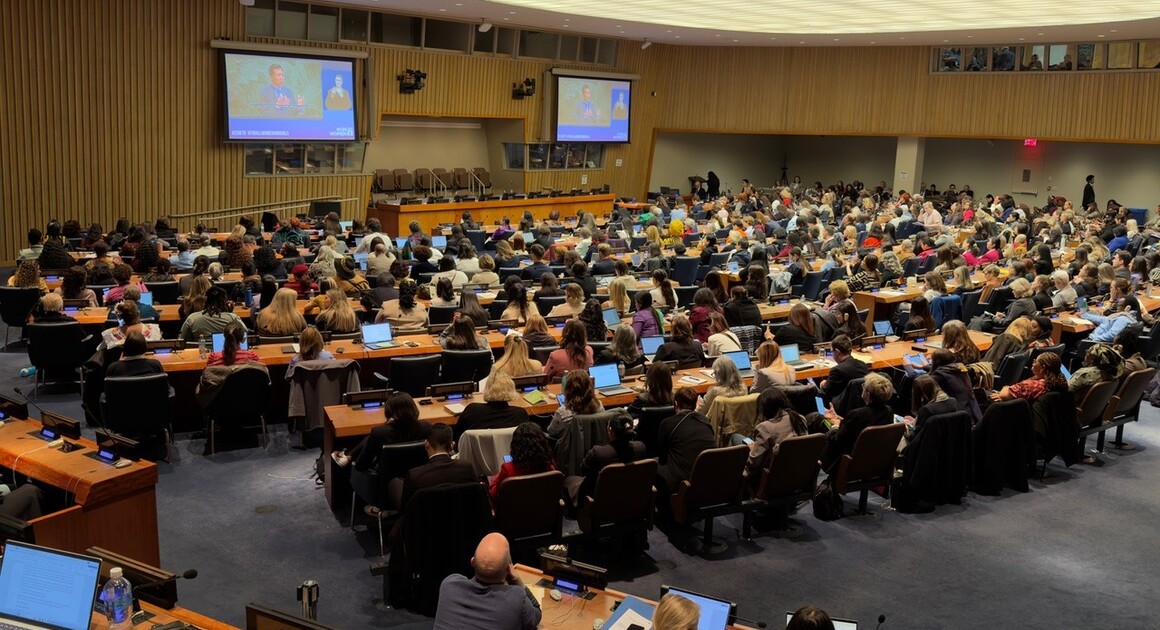
At the 70th session of the Commission on the Status of Women (CSW70), PSI -represented by delegates from the United Kingdom, Canada, and Latin America -celebrated the adoption of Agreed Conclusions on strengthening access to justice for all women and girls. The document, finalized in New York on 9 March 2026, marks meaningful progress in labor rights and workplace justice. Yet PSI cautions that it falls short on a core priority for the global trade union movement: the explicit recognition of care as a fundamental human right.
The Agreed Conclusions reaffirm global gender equality commitments and urge States to build inclusive justice systems by repealing discriminatory laws, dismantling structural barriers, and ensuring equitable legal frameworks.
It's important to note that, for the first time in the 70-year history of the Commission on the Status of Women, the Agreed Conclusions had to be adopted by recorded vote rather than by consensus. This unprecedented step resulted from the disruptive and regressive position of the United States, which cast the sole vote against the document. Of the 45 member states, the final tally was 37 in favor, 1 against (United States), and 6 abstentions, with one position effectively empty (resulting in 44 votes cast).
A key breakthrough, from PSI's viewpoint, is the explicit linkage of labor rights, gender equality, and access to justice in the world of work. The text obliges States to enact, strengthen, and enforce laws upholding women's right to work and full enjoyment of labor protections, consistent with International Labour Organization (ILO) conventions.
It advances trade union priorities by championing decent work for women, equal pay for work of equal value, and the elimination of employment discrimination—including maternity-based bias. It commits to eradicating violence and harassment at work (an agenda PSI has long championed) and affirms workers' rights to organize and bargain collectively as essential to labor justice.
The conclusions also call for robust social protection systems and a shift from informal to formal employment—critical in regions like Latin America and Africa, where millions of women endure precarious conditions. Crucially, they mandate effective remedies and justice mechanisms for labor violations, ensuring rights translate into reality.
On care, the text pledges investments in the care economy, stronger support systems, and efforts to recognize, reduce, and redistribute women's disproportionate unpaid domestic and care burdens. While this builds on prior discussions, it stops short of declaring care a human right. This omission risks framing care primarily as a market commodity rather than a public good and a core State responsibility.
PSI views this as a missed opportunity. "Care is not merely an economic sector," said Julie Bouchard, President of FIQ (Canada) and North American Titular on PSI World Women’s Committee (WOC). "It must be enshrined as a human right, delivered through universal public systems that provide decent work, adequate funding, social protection, and union rights for care workers. Rebuilding the social organization of care means prioritizing public services and dignified conditions for those who provide it."
The CSW70 conclusions represent real progress amid challenging multilateral dynamics, but they highlight the limits of current consensus. For PSI, the path forward lies in advocating for public care systems that treat care as a structural social right—essential for gender justice, equitable societies, and true democratic progress. The trade union movement will continue pushing governments to take this ambitious step.