
Building Union Strength: Municipal workers’ union in Brazil grown by 90% in 15 years with a unionisation rate of 37.8%
Jun 17, 2026
The Unified Trade Union of Municipal Public Service Workers in Blumenau (Sintraseb), led by a young woman, currently has a unionisation rate that is double the national average for the public sector – which stands at 18.9 per cent – and four times higher than the country’s overall average
A strong presence in the workplace, training for union leaders, and ongoing investment in communication are the main initiatives pursued by the union representing municipal workers in Blumenau, a town in the interior of Santa Catarina in southern Brazil. The unionisation rate among active municipal workers in Blumenau currently stands at 37.8 per cent, double the national average for the public sector (18.9 per cent) and four times higher than the country’s overall average.
Recent results show that, through struggle and sustained efforts to secure decent working conditions and high-quality public services, workers recognise the union and value its historic achievements. “We are witnessing historic moments in the struggle for rights: at every meeting we hold, we set new records for attendance. We are also securing our rights through dialogue, because the municipal government has now understood the strength we possess and what we can achieve with it,” emphasises the union’s general coordinator, Geici Maiara Brig, former coordinator of the Regional Youth Committee of Public Services International for Inter-America.
The union was founded in 1995 following the merger of previous trade unions. From 2009 onwards, the organisation began adopting innovative political strategies to strengthen the union, including a constant presence in workplaces and training programmes, to demonstrate to workers the effectiveness of collective struggle. Since then, membership has risen from 3,091 in 2009 to 5,882 in 2026, representing a 90.3 per cent increase over the period. This accounts for 37.8 per cent of the municipality’s 15,148 public sector workers.
A constant presence in the workplace
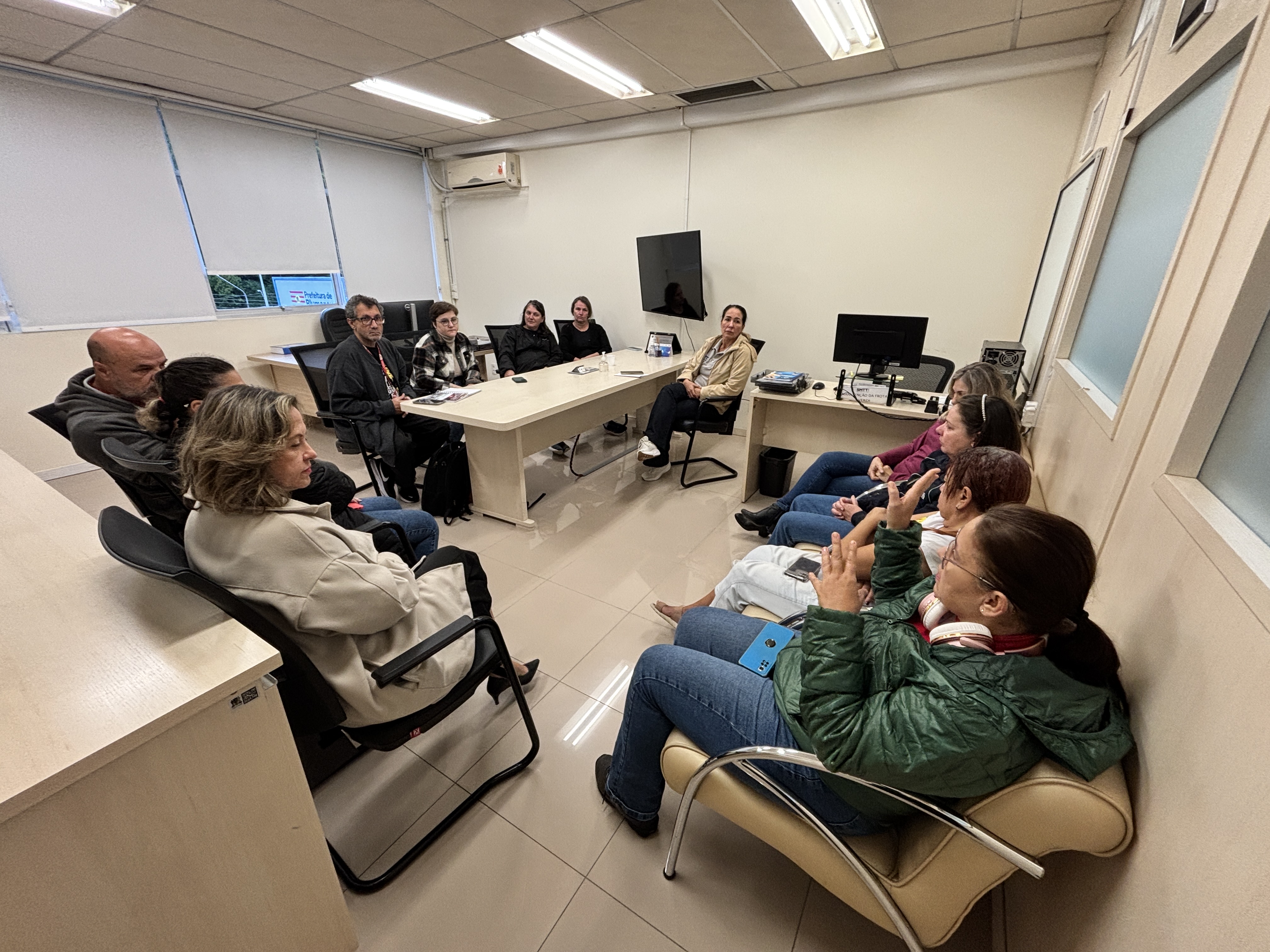
Every day, a group of union leaders travels to different neighbourhoods in Blumenau to meet civil servants at their workplaces and listen to their demands, acting as a direct intermediary between workers’ needs and the local council. This strategy is possible because the union is strong and well-structured, and it also helps build trust among workers. Through this direct contact, the union can hold ongoing negotiations and work to resolve demands with the local council, showing the workforce that union action delivers tangible results.
The union also offers various benefits to its members:
Legal support: specialist professional support to advise and defend public sector workers in labour, administrative, or social security disputes.
And an active voice and support in the collective struggle: a channel of representation for individual and collective grievances, fighting against harassment and the deterioration of working conditions in the municipal public service.
One example of the results of this strategy is Shirlene Cristina Adriano, a worker in the early years education sector, who explains that she joined Sintraseb after learning about the union at her workplace. “Whenever I have any queries or need information, the union leaders assist me with great care and respect. I’m so happy to be part of this organisation. Since I joined, I’ve been able to see that the public service sector has only moved forward, as our Sintraseb has fought tirelessly to support us,” she says.
Sintraseb’s constitution also requires each workplace to have at least one representative, responsible for conveying colleagues’ concerns to the union leaders. In this way, even when it is not possible to be in direct contact with everyone, the union remains aware of the realities facing the sector and can take the necessary action.
Among the many key figures working side by side with the union is social worker Tiago Wilhelms, who has previously served as a workplace representative. He explains that he was slow to join because he did not understand the union’s importance or how it operated, but that changed in 2024. “I started paying more attention to Sintraseb when some union leaders came to my workplace to share information and, in the process, answered some questions I had. After that, everything changed. Now I understand that the union’s strength lies precisely in being close to its members. This approach gives credibility to public sector workers, who know they have someone they can count on,” he says.
The organisation also runs ongoing campaigns to support and protect public service workers. The most recent ones have focused on the privatisation of the mobile emergency healthcare service. It well succeeded, by the way. The campaigns also work to combat harassment, disrespect, and violence suffered by municipal civil servants.

“The union is a constant collective endeavour. We are leaders at the helm of the organisation, but we do not build anything on our own. The union has a history of mass mobilisation, securing victories in pay campaigns, minimum wage increases, the reorganisation of career structures, and the guarantee of benefits such as meal vouchers and the 13th-month salary, and we are very transparent about everything we do. All the more so as we represent over 15,000 civil servants. Everything we have achieved was only possible because our members stood with us, believing in the struggle,” says General Coordinator Geici Bring.
Training as a key driver of growth
Strengthening the union’s work also involves ongoing training for the leadership. Every week, union leaders hold coordination meetings to monitor demands, assess results, and define action strategies. In addition, regular meetings with the entire leadership ensure that decisions are made collectively and that the course of action is aligned with the workforce’s needs.
The organisation also invests in training union leaders, providing courses in communication and union organisation to strengthen workers’ representation and improve internal workflows.
The role of communication
The union has also invested heavily in strengthening its communication capabilities, expanding its presence particularly on digital media platforms. All of Sintraseb’s activities are publicised in real time on social media and on the union’s website. Even those unable to attend the organisation’s activities in person have access to information, updates, and the outcomes of actions taken at assemblies, meetings, negotiating tables, workplace visits, and mobilisations, enabling members to follow the union’s work clearly and transparently.
This process also strengthens public sector workers’ trust in the union. “By getting a closer look at the work carried out by union leaders, the progress made, and the challenges faced in negotiations, workers are able to better understand the union’s role and feel more confident in trusting and participating in collective organisation,” says coordinator Bring.
The results of this strategy are reflected in the figures. While the global trend on social media in 2025 was a decline in organic reach, particularly on Instagram, Sintraseb recorded a 448 per cent increase in the reach of its posts. In June 2026, the union had 6,643 followers on Instagram, representing around 44 per cent of the municipality’s active civil servants. On Facebook, meanwhile, the page had reached 9,076 followers, equivalent to over 80 per cent of the active workforce. The data demonstrates a rare capacity for communication within the Brazilian trade union movement.
Sintraseb has been demonstrating strength, credibility, and a tangible presence in the lives of municipal civil servants. The membership figures, the growth in unionisation, and the reach of its communications show that, in Blumenau, the workforce recognises the trade union as an essential tool for protecting, securing, and defending their rights.
Membership information comes from the Inter-Union Department of Statistics and Socio-Economic Studies (Dieese), based on data from the Continuous National Household Sample Survey (Pnad), produced by the IBGE (Brazilian Institute of Geography and Statistics), in 2025.